Process documentation field guide
Turn a process transcript into a usable SOP.
A transcript records what people said. A controlled procedure records what an operator must do, who owns the result, what happens when the normal path fails, and how completion is proved.
One bounded workflow with traceable source notes, explicit unknowns, numbered actions, quality checks, an exception path, and release metadata.
- 01Set the boundary
- 02Classify the talk
- 03Build evidence
- 04Write controls
- 05Resolve gaps
- 06Cold-read test
- 07Release
Do not clean up the transcript line by line. Extract a process from it.
Recordings contain side conversations, personal habits, old rules, unresolved disagreements, and details that should never appear in a shared procedure. The conversion job is to preserve process evidence while removing noise and refusing to invent missing decisions.
Step 01
Set the process boundary first
Write the four facts below before extracting any actions. If the transcript covered several workflows, choose one and put the rest in a backlog.
Step 02
Classify what people said
Tag transcript segments before turning them into instructions. The label determines whether a statement belongs in the draft or in the question list.
- Agreed rule: the group clearly confirmed the action, owner, threshold, or outcome.
- Observed practice: someone described what happens today, but approval may still be required.
- Open decision: the group debated an option or left a question unresolved.
- Context only: history, opinion, side discussion, or detail that does not change execution.
Agreed rules and confirmed practices become procedure candidates. Open decisions become questions. Context stays out.
Fictional extraction example
Build an evidence ledger before writing prose
Keep a timestamp or line reference beside each candidate. This makes review faster and prevents a polished sentence from hiding an unsupported assumption.
| Source note | SOP candidate | Status |
|---|---|---|
| 12:14 — “When the request arrives, I check the required fields.” | Validate the request before creating the work record. | Confirm field list |
| 16:02 — “I ask Jordan when the discount is over ten percent.” | Route discounts above 10% to the approval role. | Replace person with role |
| 19:47 — “Then it is done.” | Define the saved record or handoff that proves completion. | Completion unknown |
Step 03–04
Convert evidence into operational controls
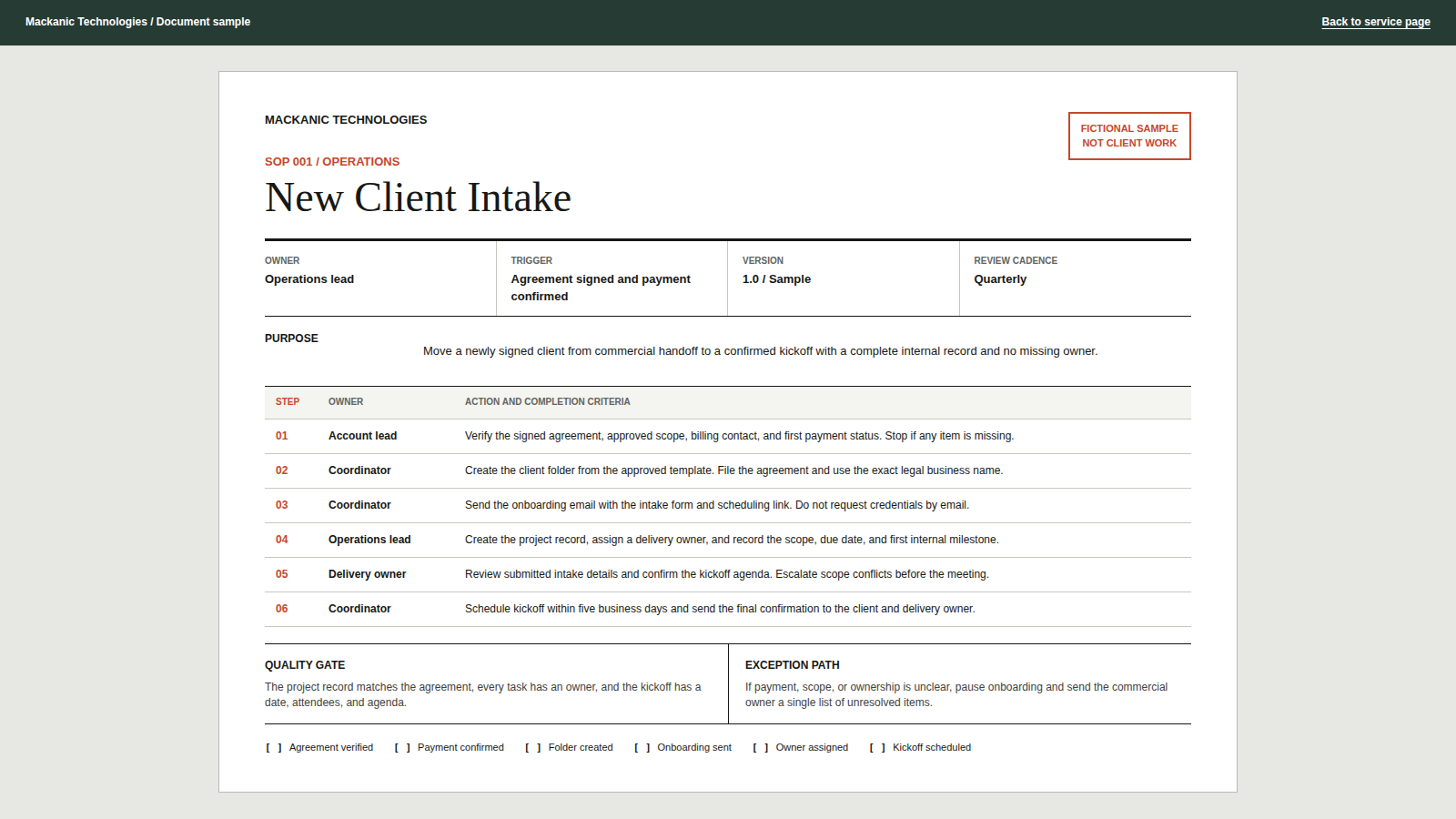
Each procedure row should answer four questions without requiring the operator to replay the recording.
- Owner: which role performs or approves this action?
- Action: what single observable thing does that role do?
- Input: what record, condition, or prior result is required?
- Complete when: what evidence shows the action passed?
Start actions with verbs. Replace names with roles. Turn “normally,” “unless,” and “if it is urgent” into explicit decision rules. Put the most important verification immediately before the final handoff.
Step 05
Resolve gaps without inventing details
Consolidate unknowns into one review list for the process owner. Do not bury assumptions inside fluent instructions.
- Which role owns the handoff when the primary operator is unavailable?
- What exact threshold changes the normal path?
- Which system record is authoritative when two sources conflict?
- What should the operator do when required information is missing?
- What evidence must exist before the workflow can be closed?
Step 06
Run a cold-read test
Give the draft and a safe fictional input to someone who did not attend the recording. Ask them to explain what they would do, where they would stop, and what proof they would leave behind.
- Record every question they ask.
- Mark every step that depends on unwritten system knowledge.
- Check that exceptions stop safely instead of encouraging improvisation.
- Revise the document, then repeat the ambiguous sections.
Step 07
Release a controlled document
Add a version, effective date, document owner, approver, and next review date. Keep the source transcript only where its access controls and retention rules allow it. Archive or replace stale procedure versions so operators can identify the current one.
Redact before sharing or pasting.
Remove passwords, private keys, recovery codes, payment information, bank details, customer-identifying data, private contracts, and unnecessary screenshots. Replace real records with fictional examples wherever possible.
Seven-point release gate
Check the finished SOP
- The trigger and final completion state are observable.
- One accountable role owns the process and each handoff has an owner.
- Prerequisites and required inputs are explicit.
- Each numbered step contains one primary action.
- Critical steps state what evidence proves completion.
- At least one exception path says when to stop and escalate.
- Version, effective date, owner, and review timing are recorded.